
There are days when dinner needs to be impressive.
And then there are days when you just want something warm, creamy, and comforting enough to make you forget that it’s already dark outside at 5 p.m.
That’s where this Classic Pumpkin Soup comes in.
It’s thick and velvety without needing a complicated ingredient list. Fresh pumpkin does most of the work, while onion, garlic, and broth give it that savory flavor that keeps the soup from tasting like you’re drinking pumpkin puree.
Best of all, the actual recipe is wonderfully straightforward.
Chop. Simmer. Blend. Finish.
My favorite kind of kitchen math.
Why You’ll Love This Pumpkin Soup
What makes this soup so good is actually what isn’t in it.
There isn’t a giant spice cabinet situation happening here. The pumpkin stays the star.
Onion and garlic add savory depth, broth gives the soup more flavor than water alone could manage, and a little cream, half-and-half, or milk rounds everything out at the end.
And here’s the nice part: the cream isn’t what makes the soup thick.
The blended pumpkin does that all by itself.
So even if you choose milk instead of cream, you’re still getting that thick, smooth pumpkin-soup texture.
What You’ll Need
The ingredient list is refreshingly short:
- Fresh pumpkin or butternut squash
- Onion
- Garlic
- Low-sodium vegetable or chicken broth
- Water
- Salt
- Black pepper
- Cream, half-and-half, or milk
That’s it.
No mystery ingredients hiding halfway through the recipe. No emergency grocery-store trip because you suddenly discovered Step 4 requires something you’ve never heard of.
Which Pumpkin Should You Use?
Sugar pumpkin or butternut squash are good choices.
And there’s one pumpkin you should leave on the porch:
Halloween carving pumpkins.
They’re technically edible, but they’re grown more for looking spooky than tasting fantastic.
This soup deserves better.
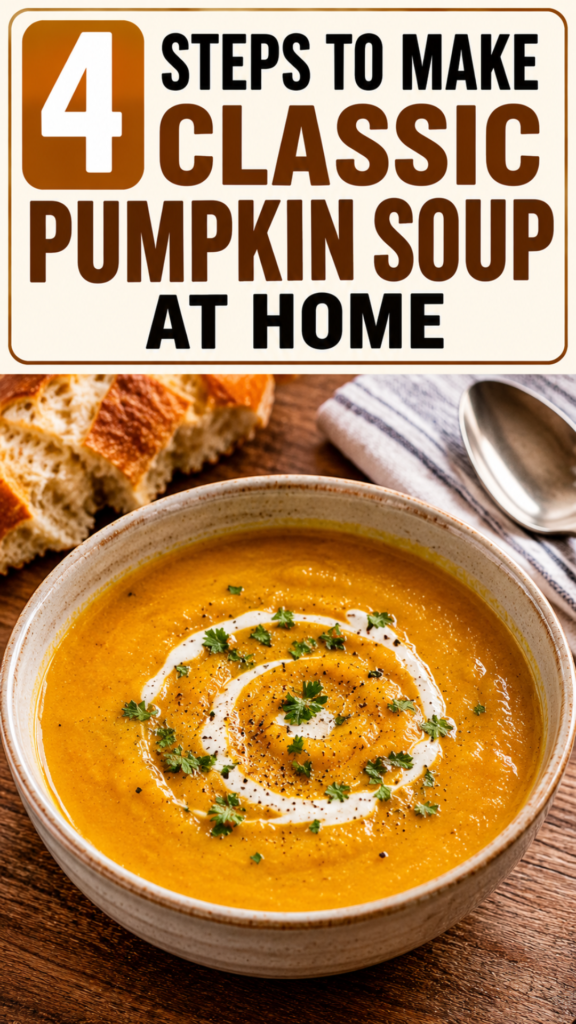
4 Steps to Make Classic Pumpkin Soup
Step 1: Get Everything Into the Pot
Start by preparing the pumpkin.
Remove the skin and seeds, then cut the flesh into chunks.
Put the pumpkin into a pot along with the sliced onion, whole peeled garlic cloves, broth, and water.
The liquid won’t completely cover the pumpkin, and that’s okay.
Bring everything to a boil uncovered, then reduce the heat and let it simmer rapidly.
No sautéing the onion first.
No roasting three separate trays.
Everybody gets into the pot together.
Step 2: Cook Until the Pumpkin Is Tender
Let the pumpkin simmer for about 10 minutes, or until it’s very tender when tested with a butter knife.
You want it properly soft because we’re about to turn the whole pot into silky soup.
If the pumpkin is still putting up a fight against the knife, give it a little longer.
We’re making soup, not testing pumpkin self-defense skills.
Step 3: Blend Until Smooth
Take the pot off the heat.
Use a stick blender to puree everything until the soup becomes completely smooth.
This is the satisfying part.
One minute you’ve got chunks of pumpkin and onion floating around the pot, and shortly afterward you’ve got thick, golden-orange soup.
If you’re using a regular blender instead, allow the soup to cool somewhat first. Hot soup trapped inside a blender can build pressure, which is exactly the kind of kitchen excitement nobody asked for.
Step 4: Season and Finish
Taste the soup and season it with salt and black pepper.
Then stir through your choice of cream, half-and-half, or milk.
If you’re using cream, don’t boil the soup after adding it because the cream can split.
And that’s really it.
Four main steps and you’ve got a pot of smooth, creamy pumpkin soup ready for bowls.
Do You Need Cream for Pumpkin Soup?
Nope.
Cream adds richness, but it isn’t responsible for the soup’s creamy texture.
That comes from all that blended pumpkin.
You can use milk instead and still end up with a beautifully thick soup. Half-and-half works too.
It’s nice having a recipe where “creamy” doesn’t automatically mean “we emptied the entire carton.”
How to Serve Pumpkin Soup
Ladle the hot soup into bowls and, if desired, finish it with a little cream, black pepper, and parsley.
Then bring out the crusty bread.
This isn’t optional in my emotional interpretation of pumpkin soup.
A thick soup like this practically exists to have a piece of bread dragged through it until the bowl is suspiciously clean.
Dinner rolls, garlic bread, cornbread, or another good bread for dunking can work too.
Why Onion and Garlic Matter
With such a simple soup, small ingredients make a noticeable difference.
Pumpkin naturally brings sweetness. Onion and garlic push things back toward the savory side, while the broth adds another layer of flavor.
That’s why a recipe with so few ingredients can still taste like proper dinner instead of warm pumpkin baby food.
Not exactly the cozy fall vibe we’re chasing.
Can I Use Butternut Squash?
Yes.
Butternut squash works well in place of pumpkin.
In fact, for U.S. readers who don’t regularly see good eating pumpkins at the grocery store, butternut squash may be the easiest option.
Just don’t confuse a good eating pumpkin with the giant carving pumpkin staring at you from the Halloween display.
That guy already has a job.
How to Store Pumpkin Soup
Pumpkin soup is a good make-ahead option.
Store leftovers in the refrigerator for 4 to 5 days.
It can also be frozen for up to 3 months.
After thawing, simply reheat it using your preferred method.
If the reheated soup seems thicker than you’d like, loosen it with a little water.
If it’s somehow too thin, let it simmer on the stove for a while to reduce and thicken.
A Simple Soup Worth Keeping
I think that’s what makes this Classic Pumpkin Soup such a useful recipe.
It doesn’t try to turn pumpkin soup into something complicated.
You’ve got sweet pumpkin, savory onion and garlic, flavorful broth, and just enough dairy at the end to round everything out.
Serve it piping hot with something crusty for dunking and you’ve got the kind of easy fall dinner that feels considerably cozier than the amount of work involved.
And when dinner requires one pot and four basic steps?
I’m certainly not going to argue with it.